
>>> NEW ALBUM “Good Enough by Hidemi Woods” Streaming [Spotify] [Youtube Music] MP3 purchase[Amazon Music][Apple Music]

  • the new Kyoto

    the new Kyoto

    Kindle and Audiobook available at Amazon.com
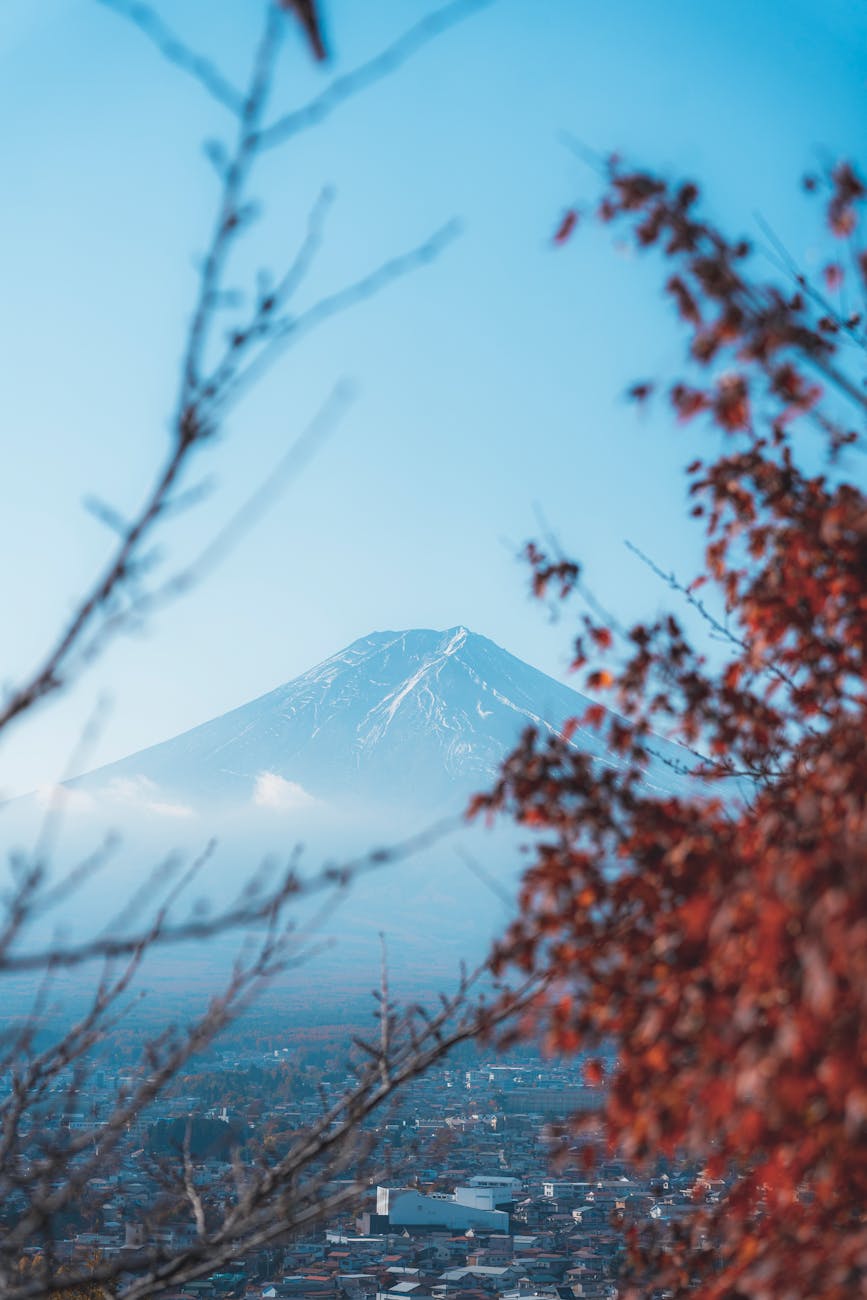
    mount fuji behind an autumn tree

    When I spent 40 minutes aboard the bullet train bound for Kyoto from Tokyo, an alarming notion popped into my head. “Did I miss Mt. Fuji?” It’s around this time that Mt. Fuji comes into view closely in the bullet train window.

    Somehow Mt. Fuji is a special mountain for Japanese people. It’s said that seeing the first sunrise of the year from the top of Mt. Fuji brings a happy new year. Many of them want to climb it once during their lifetime. They regard it as something holy and good luck.

    I myself try to see it every time I take a bullet train to Kyoto, and pray to it for a good trip. It was cloudy and rain looked imminent on that day of my latest trip to Kyoto. Whether the train already passed Mt. Fuji or it wasn’t visible because of thick clouds was uncertain. The outcome of the trip depended on Mt. Fuji. I felt that this trip might end terribly if I couldn’t see it, and I looked for it frantically.

    “There it is!” Above the dark clouds, its top section poked out clearly. “I see it! A nice trip is assured!” I was relieved and in high spirits. While I jinx it when I don’t see it, however, I’ve had horrible trips even when I saw a clear Mt. Fuji. Although I duly understand an outcome of a trip doesn’t have to do with whether I see it or not, there’s a reason why I’m nervous enough to pray to the mountain.

    A trip to Kyoto means homecoming and meeting my parents. Three out of every four visits, they give me a hard time. They insult me, deny me and complain everything about me. I sometimes feel my life is in danger when I’m with them because of their relentless attacks. Not to be strangled by them while I’m sleeping, I avoid spending the night at my parents’ home and stay at a hotel instead.

    I would rather not visit and see them, but I know it would make things worse. I couldn’t imagine how this particular trip would go especially as it was my first visit since my parents sold their house. They could no longer afford to keep their large house and its land inherited by our ancestors. Their financial crunch made them sell it where my family had lived for over 1000 years. They moved out to a small, old condominium outside Kyoto.

    Thinking about the situation they were now in, I couldn’t imagine their state of mind other than being nasty. The bullet train slid into Kyoto Station after two and a half hours. I stepped out on the platform for the first time as a complete tourist who didn’t have a house or a family there. To my surprise, Kyoto looked different. I couldn’t tell what and how, but it was decisively different from Kyoto I had known. It used to look grim and gloomy as if it was possessed by an evil spirit. But now it was filled with clean fresh air and looked bright. I would see all but mean people, but they also turned into nice people with smiles.

    I checked in a hotel and looked out the window. Rows of old gray houses were there. I used to think Kyoto was an ugly city with those somber houses, but I found myself looking at even them as a tasteful view. I’d never thought having the house I grew up in torn down and parting with my ancestor’s land would change the city itself altogether. Or maybe, it was me that changed…

    Episode from

    Travel to Kyoto: Singer, Songwriter and Author from Kyoto, Japan by Hidemi Woods

    Kindle and Audiobook available at Amazon.com

  • genetic parsimony from atavism

    genetic parsimony from atavism

    I was brought up by my grandparents who led an extremely saving life. Although we were well off and lived in a big house back then, most lights were kept off to save the electric bill and the house was always dark. Turning on the TV was available by my grandfather’s daring permission. We would eat dinner in the poor light under a small kitchen fixture.

    My family had farmed in those days and what we ate were vegetables we grew in our fields. We grew some kinds for our family’s use, but most vegetables on our table were what were too damaged to be sold in the market. We ate eggplants almost every day in summer and spinach in winter. Meat seldom appeared and we lived like vegetarians. Protein was supplied mainly by beans from our fields. We kept hens that brought us eggs. Sometimes my grandmother got cheap fish at a nearby mom-and-pop store and grilled it that seemed to have more small bones than flesh. Every meal was bland and tasted terrible, as my grandmother saved seasoning.

    Snacks were hopeless too. Since my grandparents had tried not to waste money on them, we had only few snacks of Japanese style cookies that occasional visitors brought as gifts. They were damp and limp because we kept them as long as we could. I usually didn’t have any appetite and was thin probably owing to that eating habit.

    When I visited a relative’s house and ate there once in a while, everything on their table looked gorgeous. In that case, I devoured and called the house a restaurant. My relatives would wonder and ask me what I ate at home while they were watching perplexedly the way I was eating their regular meals.

    My grandmother spent most of her spare time sewing and mending something. She mended holes in socks and patched futons so that we could use them for a long time. I had never seen her get new clothes and she wore an old kimono every day. Her scarce cosmetics were the cheapest ones on the market. My grandfather went out by using a senior citizen’s pass for a free ride of public transportation, wearing an ancient drooping jacket and shoes with a hole. Whenever he ate out, he brought back the leftovers in a doggy bag.

    As a child, it was a mystery to me why they lived like that although they had plenty of money. I hated it and longed for a better life. Then I grew up and got to live in the way I liked. And now I find myself mending tirelessly my tattered socks. I’m not rich, but not that I can’t afford new ones. I replace elastic at the waist of pants, turn off the lights in my apartment as much as I can, buy and eat old food that is half price, ask for a doggy bag, and find free samples for my cosmetics. I think it’s not about saving money. I simply hate wasting. Not just money, but anything. If we waste time continuously, we will end up wasting our whole life. When I avoid wasting something successfully, I feel like I’m smart and that feeling brings me joy. I imagine my grandparents thought the same way. I gradually don’t loathe being stingy myself while I’m duly aware that someone notices and sneers at mended marks on my socks…

    Episode from Hidemi Woods

    Visit HidemiWoods.com

  • a wise shopper

    a wise shopper

    I’m always impressed by the size of houses that appear in TV shows and movies of U.S. Even when the setting is for a poor family, they live in a mansion by Japanese standards. That’s why the story is often confusing when the house tries to tell how much its inhabitants go through hardship. Japanese people live in tiny space as much, including myself of course.

    One of my favorite pastimes is bargain-hunting. I like searching for goods that are marked down by 80 percent or more and getting them. When I’m out for a store, I keep my eyes peeled for a cart or shelves of bargain items and pounce on like a hyena. Those items usually have a small sticker of the discounted price over the price tag where the list price had been shown. Some of them have a layer of numerous stickers as they got discounted more and more repeatedly. I peel the sticker off carefully to look at the former list price and to see how much it’s reduced. Sometimes the reduction is huge, which means I hit the jackpot. Imagining there are people who got it at the list price, I feel like I’m a wise shopper and it would be foolish if I didn’t get it. So I buy things dirt cheap, most of which are clothes.

    Back in my apartment, I squeeze the catch into my closet. The closet is already full with those discounted items and hangers are no longer necessary for my clothes because they are sandwiched each other too tightly to drop. I use many cardboard boxes to store my stuff that make my tiny apartment even smaller. My apartment doesn’t have a walk-in closet, but it seems like my apartment itself has turned into one and I live inside it.

    I can’t throw them away because it would make a profit of a discount a loss. A number of my cardboard boxes are growing and I don’t catch up. I can’t find one particular item when I really need it. Although I know I have gotten it and stowed somewhere, I rummage around and just can’t find it. And that item shows up from somewhere when I least need it. And it’s gone again somehow when I need it. As I repeat that, I can’t tell why and what for I got it in the first place.

    The other day, I made a firm resolution to clear some space in my apartment by putting my stuff in order closely. It was a troublesome job but I tried to make my apartment bigger and look better. It worked to some degree and my living environment was improved a little. Only a few days later, I needed a scarf when I was going out. And I couldn’t remember which cardboard box I had stored my scarves in and where I put the box. I again pulled back out numerous boxes and opened them. I couldn’t find it. All my scarves that I had collected through the years by bargain-hunting was sucked into a black hole in the galaxy far, far away and disappeared. I wonder how many years will pass until I see them again…

    Episode from Hidemi Woods

    Visit HidemiWoods.com

  • you can cry hardest

    you can cry hardest

    I’m a singer-songwriter living in Japan. Yet, I’m totally unfamiliar with Japanese recent entertainment. As I haven’t caught up with Japanese pop music, TV dramas and movies for decades, I don’t know any tunes, any titles and any names and faces of a band, a singer or an actor. I have lost interest in Japanese entertainment as a whole except for comedians for a long time. The reason is simple: there’s nothing worth listening or watching at all. Every single thing I encounter is rubbish and I have stopped trying to find something good. It seems that as a nation falls into decay, its entertainment perishes accordingly.

    The most common sales pitch for movies in Japan is ‘You can cry hardest.’ The tears in the pitch don’t mean what we shed when we are moved or touched or happy. They mean specifically the ones when we are sad. The sadder a story is, the bigger hit a movie scores. As a result, movies that center only on death of one’s beloved are overrun in Japan. That kind of movie is what I want to watch least. I prefer foreign movies which themes exist, touch me, and consequently make me cry. But Western films are not sad enough for Japanese people and every year the number of foreign movies that come into theaters shrinks. Even the Japanese comedy TV shows are aired less and less although they are the only domestic entertainment I can enjoy.

    I used to be an avid frequent visitor of a Disney theme park in Tokyo where I could feel like I’m visiting America. Sadly, Japanese taste has been greatly increased there and changed its atmosphere so much that I’ve long since stopped going.

    While less Western culture flows into Japan, more and more Japanese games and animations are going abroad. I’m afraid that the Japanese negative spirit might brainwash teens and children in U.S. through them. Thanks to cable TV I recently subscribed, I enjoy TV shows and movies from U.S. every day. Unlike domestic counterparts, good ones are abundant throughout the channels and I can easily find myself absorbed in. Zombies, devils, serial killers and the FBI come at me every night and I fight against them. That gives me food for thought, and makes my brain active and me feel positive.

    I’m duly aware of a lot of problems, but I can see hope exist in U.S. I suspect that’s the very reason why Japanese people are inclined more for domestic culture. They have lost hope and want to share denial of hope with others. They see themselves die with characters in the Japanese movies.

    I will stay away such a negative and would rather wander around cable TV channels from U.S. I intend to devour good entertainment as much as possible for my own survival. And I believe that will lead me to create good works of myself and help them be part of good entertainment. It’s not a matter of fame and money any more. It’s a matter of life or death. Well, of course it’s even better to stay alive with fame and money, I admit…

    Episode from Hidemi Woods

    Visit HidemiWoods.com

  • jackpot

    jackpot

    Kindle and Audiobook available at Amazon.com

    A dream I wish to have in the night most isn’t about dating a Hollywood star, or making a great hit with my song. It’s not about my parents saying to me with tears “We were wrong. We’re sorry.” either.
    It’s about numbers. I once saw a woman on TV who won 4 million dollars by the lottery with the numbers she had seen in her dream. Shortly after that, I myself saw numbers in my dream and began to buy a lottery ticket with those numbers. I won $10 for several times and $100 once, if not 4 million dollars.
    Since then, I’ve always waited for numbers to appear in my dream, the numbers for the jackpot. And the other night, new numbers appeared in my dream for the first time in months. I was convinced that the time had come. I rushed to the only lottery stand in this small town and got a ticket for five consecutive drawings with those numbers.
    I lost them all. I went out again in the snow with my partner for five more drawings. At the stand, he found that he had left an ATM card at home, which was necessary to get a lottery ticket. He acted as if he had lost 4 million dollars on the spot and looked up the sky with despair.
    I’d never thought the numbers from my dream gave him so much hope. I ended up coming back again to get a ticket before the next drawing day. While I rely on my dream numbers and keep meeting the deadline for each drawing rigidly, a possibility of the jackpot is practically none…

    Episode from

    Japanese Dream: Singer, Songwriter and Author from Kyoto, Japan by Hidemi Woods [Click to Buy at Amazon.com]


    Also available Audiobook